Monday, 25 September 2017

Few quick observations @ Deep Sky Meeting 2017

Observing place: Tähtikallio, Artjärvi, Finland (Deep Sky Meeting 2017)
Date: 23./24.9.2017
NE Lim.mag: 6.8 (zenith)
SQM-L: 21.38 (zenith)
Background sky: 7/10 (fairly good)
Seeing: 7/10 (fairly good)
Transparency: 6/10 (decent)
Weather: Clear, slight breeze, +10°C.

Two of the observatory domes harboring Alluna RC-16 16" f/8 (left) and 36" Astrofox (right)
From the get go, I knew that time constraints, constant (human) traffic and stray light would be a big issue so I only had a few objects in mind and even less objects to sketch. I was simply armed: only packing my 4.5" Orion SkyQuest but I had the privilege to use the 10" GSO of Juha Ojanperä.


The weather was decent with surprisingly poor transparency. SQM-L readings were between 21.20 to 21.40. Seeing was so so and the images at the telescope(s) appeared too "soft" to my liking. It must  have been a transparency related issue (including a regular Finnish humidity issue) but despite the good SQM-readings from all over and several sources... I noticed right away that the weather just wasn't all that good. I showed a few objects to the audience and managed to properly try to view / view only a few objects:

NGC 206 + NGC 604 (GSO 10") - Both easily visible @ low magnification.

NGC 1499 (XT 4.5") - Decent view with 40 mm Celestron Plössl eyepiece + UHC filter.

Sh2-216 (XT 4.5") - I knew even without looking that I would not be able to see this object. Still had to give it a shot and most importantly getting myself acquainted with the field for a proper try using a bigger telescope.

Pease 1 (GSO 10") - Same as above. Even Messier 15 didn't look too good with the big telescope. Used the biggest magnification on M15 just to dispel my illusions of Pease 1 being an easy object to observe.

NGC 1491 (XT 4.5") - Sketched with a UHC filter. Noticed that I do not have a proper sketch of this so I did what I must.

Outer wisps of Messier 27 (GSO 10") -  Observed for a Avaruus.fi project however it proved to be far to difficult a task so instead I chose to sketch the inner regions of M27.

Wednesday, 31 May 2017

Observing challenges for season 2017-2018

The observing season has barely ended here in Southern Finland but it is already time to look ahead. I rarely do any visual observing (excluding LVAS Observer's Challenge and my column) any more but when I do, I try to concentrate on more challenging stuff. Here are a few objects I have on my to see list for the upcoming season.


Cygnus A (3C 405)

The famous 15th (visual magnitude 15.1) magnitude elliptical galaxy. One of the strongest radio sources in the sky. Wolfgang Steinicke has reported seeing the galaxy using a 14" telescope @ 450x [1].


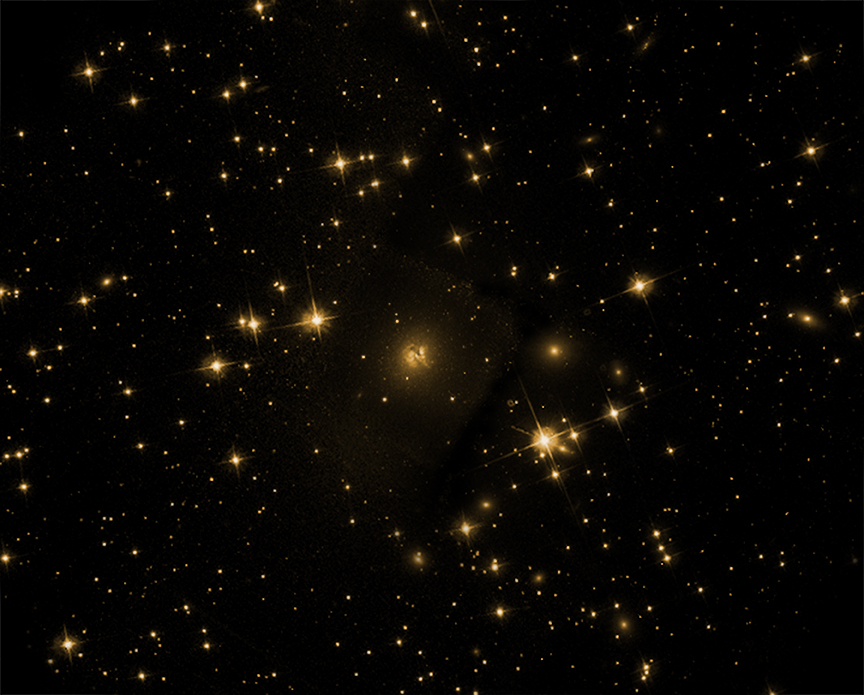
Pease 1
Pease 1. Copyright STScI / HST

I'm not a big fan of stellar planetaries and I am especially not a fan of spotting one from a dense star fields of a globular cluster. Still, worth a try as I've never tried to seriously see Pease 1.


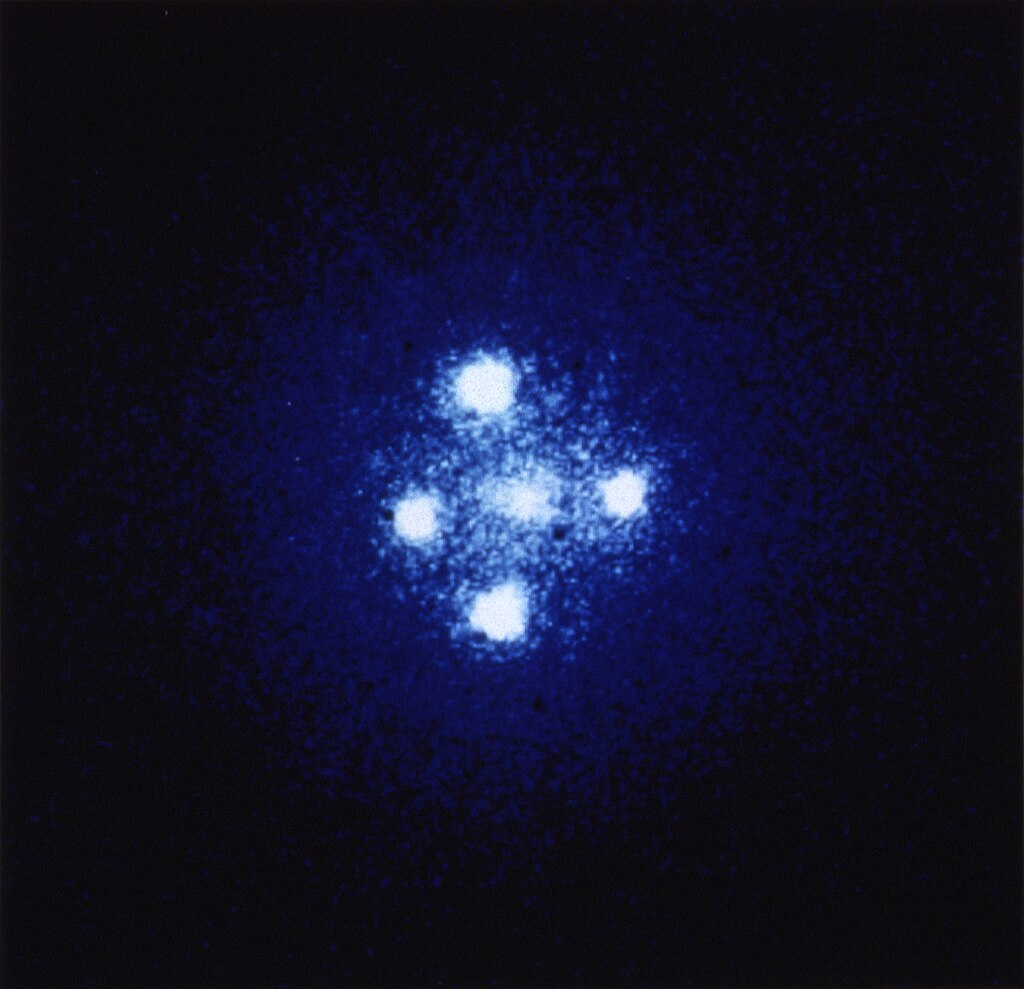
PGC 69457

Einstein's Cross. Copyright ESA

Huchra's lens. Another 15th magnitude galaxy at a somewhat low altitude in Pegasus. Seeing the actual Einstein Cross won't be happening with the 10 inch telescope but just seeing the lensing galaxy is still something.


Gyulbudaghian's Nebula (GM 1-29)

Variable nebula in Cepheus. Usually unfortunately faint.


Mayall "C" (C39) & Star B 342

Brightest globular cluster and brightest single star in Triangulum galaxy. With the extra 2 inches in aperture, seeing it will probably be fairly doable.


NGC 1554-5

A classic. Hind's Variable nebula.  Time for a new view.


Several Messier objects...

There are a bunch of Messiers I still do not have a proper sketch of. I will try to do a few of them in the upcoming season.


References

[1] http://www.klima-luft.de/steinicke/Artikel/cyga/cyga_e.htm

Monday, 3 October 2016

1.-2.10.2016 - A night in Hartola

Telescope: 10" GSO
Obs. place: Hartola, Finland
Date: 1./2.10.2016
NE Lim.mag: 7.0 (zenith)
SQM-L: 21.40 (zenith)
Background sky: 7/10 (fairly good)
Seeing: 7/10 (fairly good)
Transparency: 7/10 (fairly good)
Weather: +9°C - +2°C, humidity 74-90%, 1010 hPa, W wind 3-8 m/s, clear.

Around 7 pm the sky was still covered in clouds
Around sunset the weather still looked pretty gloomy but in the end the sky was clear at around 9.30 pm. It was also the proper first light of the new 10 inch GSO. I have used the telescope a few times before but never under darker skies.

I was fairly well armed, however had no laptop or additional sky charts with me apart from Uranometria which proved to be a pretty bad idea. I struggled to find many of the fainter objects as they were not immediately visible.

Without further ado here are some of the more uncommon described as I saw and experienced them. I will add the drawings to this post later on when I have the sketches processed.


Palomar 10 (altitude ~46°)

Despite my best efforts I could not see the globular cluster. I was exactly at the right position but could not pick out anything that resembled a glow.

Uwe Glahn reported Palomar 10 as "very faint, difficult to detect" using a 16" telescope. Iiro Sairanen described the object "very faint haze without clear shape with extremely averted vision at 176x" with a 18" telescope. So with this mind, I suppose it is forgiveable that I could not pick it out.


Messier 57 central star (altitude ~55°)

During few fleeting moments I could just see the central star @ 357x but not with any magnification below that. I managed to see a magnitude 15.3 star close to M57 fairly easily as well as a magnitude 15.7 from time to time. My previous sighting on the central star was back in 2008 using 12" GSO. My notes say: "central star was invisible @ 429x but fairly easily spotted @ 600x".


NGC 6826 outer halo (altitude ~71°)

Surprisingly easily visible as a 2' circular ring surrounding the "actual" NGC 6826 @357x. I also suspected a slightly brighter spot on the NE side of the outer halo. This seems so collaborate with a small knot visible in photographs.

IC 4677 (altitude ~66°)

Invisible without a filter but with Lumicon O-III almost shamefully easy. NE-SW elongated blob nearly midway between NGC 6543 and PPM 20675.


Veil nebula complex (altitude ~56°)

Stunning view. I did a rough sketch showing several fainter components visible in the region. Simply by using Uranometria I was able to spot at least 17 different components in the Veil nebula. Looking at a map @ Adventures In Deep Space (by http://www.astronomy-mall.com/Adventures.In.Deep.Space/Veil.big.jpg) I could see all the marked components apart from "B" even without a proper map of the region.

 
Palomar 1
(altitude ~80°)


Finally got this sucker! As soon as I found the Big Dipper-shaped asterism just north of Pal 1 - I knew I was gonna get it. However it was a lot more difficult than I had expected - same problem as with Palomar 10. I appeared as a tiny 0,5' circular glow without detail.


Abell 6 + PK 136+5.1 (HFG 1) (altitude ~70°)

Despite interference from an annoyingly bright HD 18137, Abell 6 was fairly easy to see using a O-III filter. HFG 1 was a lot more of a challenge only barely showing a 6' irregular/circular glow.


Pegasus dwarf / UGC 12613 (altitude ~42°)

Fairly bright, visible SE of a Y-shaped asterism as a 2' x 1' NW-SE elongated glow without a nucleus.


 NGC 604 (altitude ~59°)

I got inspired to view this object again after seeing a sketch made by Riku Henriksson at the DSA. Riku's sketch is an excellent representation of what I could see with my telescope - apart from the actual individual stars. There was "a string of stars" [without the stars!] visible in the NW section of the nebula as well as a stellar brightening visible in the southern section of NGC 604.
 
Cassiopeia A (altitude ~75°)

Cassiopeia A was the final object of the night. I was nearly certain I had no chance of seeing it but the 10" GSO proved me wrong. I had to wait for nearly 1.5 hours for it to climb down from zenith for a proper look. It took me quite a while to find the correct position but once I did... bang. Using a Lumicon UHC filter a circular glow was nearly instantly visible with averted vision at the exactly correct position. Cassiopeia A has been seen with an aperture below 10 inches but seeing it with the GSO from a place such as Finland is quite nice.


Morning mist

At 4 am the telescope started to look and feel quite damp so I decided to head back in.  All and all the weather was decent, although humidity started to rise to unbearable levels around 4 am as the winds calmed down. Despite it it, Messier 33 visible with the naked eye and I was very happy that I managed to avoid the forecasted Aurora Borealis display.


Full list of objects observed. Asterisk (*) = sketched.

Collinder 399, NGC 6802, Cr 399, Palomar 10 (negative observation), Messier 71, Messier 57(*), NGC 6826(*), IC 4677(*), NGC 6910, NGC 7027(*), NGC 6888(*), Veil nebula complex, Palomar 1(*), PK 80-6.1 / Egg nebula(*), NGC 7000, NGC 6991, Messier 39, NGC 7026(*),  NGC 7048, Stock 5, NGC 886, Abell 6(*), HFG 1(*), Pegasus dwarf(*), Messier 33 (naked eye), NGC 604(*), NGC 1 & 2(*), NGC 16, NGC 22, UGC 69, Andromeda galaxy, NGC 206, Messier 52 + Cz 43, NGC 7635 / Bubble nebula(*), Cassiopeia A(*).

Friday, 1 July 2016

Deep Sky column 5/2016: MCG -02-41-001, Messier 80 & Messier 4


5/2016 column features MCG -02-41-001, Messier 80 & Messier 4.


Illustration sketches:

Saturday, 16 April 2016

Deep Sky column 3/2016: OJ 287 & 3C 273


3/2016 column features BL Lac object OJ 287 and quasar 3C 273.

UGC 6132  (Markarian 421) was also featured in the draft version but was cropped later on due to length issues.


Illustration sketches:
OJ 287 - 8" Orion DSE
3C 273 - 4.5" Orion SkyQuest

Monday, 1 February 2016

Deep Sky column 1/2016: NGC 2237, NGC 2264, Trumpler 5, IC 447 and Barnard 37


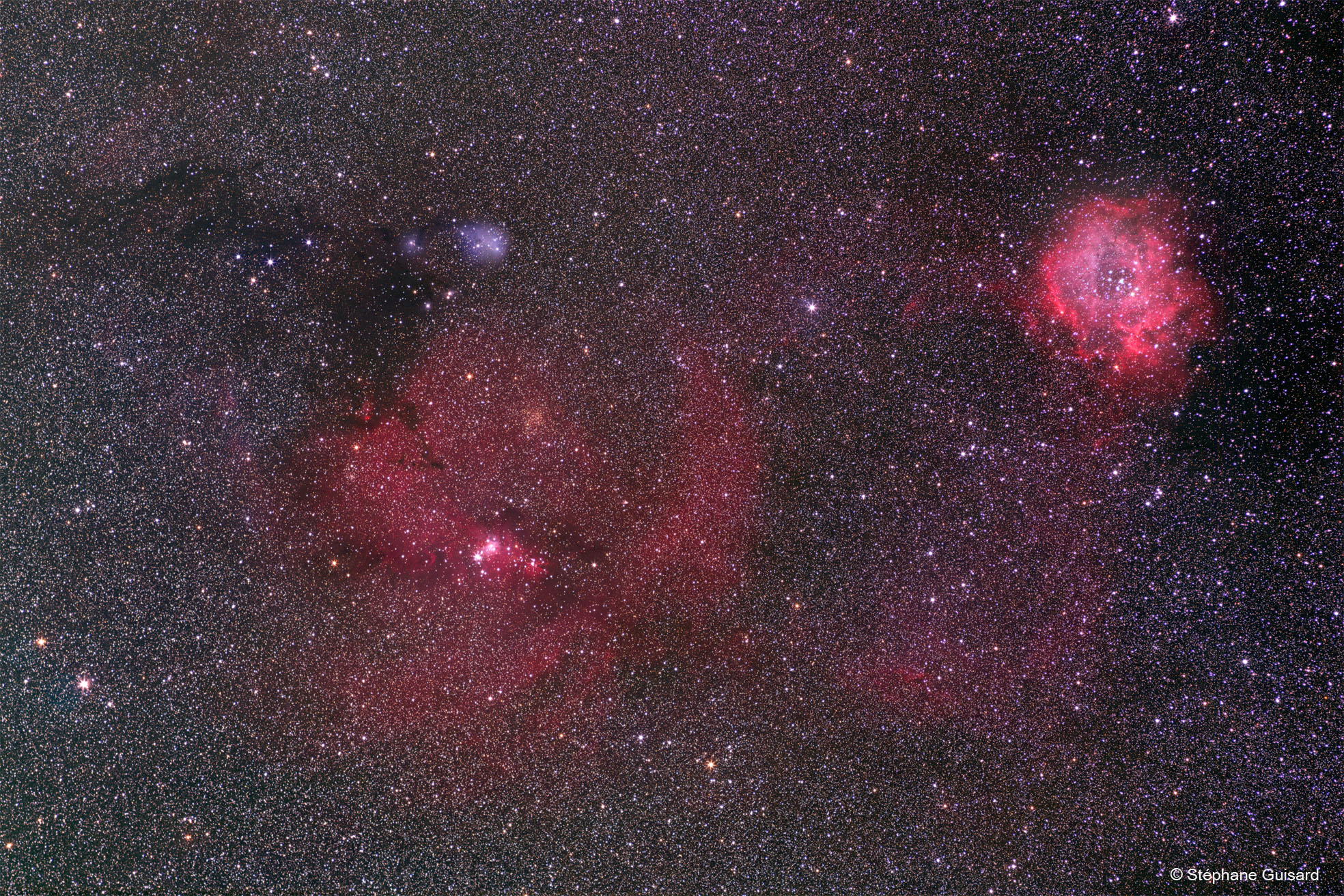
This column has a different look to it. The idea was to select a good (wide field) photograph from an interesting region in the winter sky and simply do an article based on it.

The region selected is the famous "Heart of Monoceros" featuring - most notably - Rosette and Cone nebulae. Other region under consideration was "Heart of Auriga" featuring IC 405, IC 410, IC 417 and NGC 1931 which will probably be done next year.

The image in the background is by Stéphane Guisard - http://sguisard.astrosurf.com/Pagim/SGU-Cone-Rosette-STL-200mm-M-cp8.jpg

Sunday, 10 January 2016

Treasure Island: Lynx the Bobcat


Alessi 2
Size: 30'
Type: IV 3 m
Notes: Br * 8.8

Sunday, 4 October 2015

Deep Sky column 7/2015: NGC 7789 & NGC 7243


The original column featured NGC 7789, NGC 7243 and NGC 752 but it was cropped early on.

NGC 7789 is one of the finest open clusters in the northern hemisphere. It was discovered by Caroline Herschel on 30th of October 1789 using a modest 10 centimeter f/6.4 Newton. It features roughly 600 stars within 20' of which the brightest is 10th magnitude. Visually the object is less than 10' in size.

Loosely translated my friend Iiro described the object as "a labyrinth of dark pathways and starless regions".

NGC 7243 is an old favorite of mine. Several shapes can be discerned from the object most common one being a bird flying directly to the viewer. Brightest star in the cluster is 8.5 magnitude. Size of the object is 17' with a total number of stars visible with an 8 inch Orion DSE: ~150. Illustration (from my part) featured a sketch of NGC 7243:
4.5 " Orion SkyQuest @ 101x (30')

Wednesday, 1 July 2015

Deep Sky column 5/2015: Dwarfs and Giants

Summer and non-deep sky oriented column due to midnight sun.

Massive star: LBV candidate Cyg OB2 #12 (HIP 101364). 11.4 magnitude star with ~110 M☉ and bolometric magnitude ~10.9. Dwarfed by R136a1 (~256 solar masses) in NGC 2070 (LMC - Dorado).

A star close to us: Lalande 21185 in Ursa Major. The star is only 8,3 light years away. At magnitude 7.5 is it also a naked eye object under excellent conditions. Absolute magnitude is quite faint: ~10.5.

Tiny star: Barnard's star. Closer to us than Lalande 21185 but a lot smaller: 0.14 M☉and with an absolute magnitude of only 13,2. The star has only 150 times more mass the Jupiter. Moves 10" in the sky per year - that's 90 km/s. Not discovered by E. E. Barnard.

Far far away: 6th magnitude Rho Cassiopeia. Distance estimates vary greatly: between 6000 and 16 000 light years. Commonly referred as the most distant (single) star visible to the naked eye. Radius is at least 400 R☉ then again dwarfed by UY Scuti (~1700 solar radii). Another distant star to the naked eye: V762 Cas, possibly even 15 000 light years away.

Monday, 6 April 2015

Deep Sky column 3/2015: The three phases of galaxy mergers

First phase in galactic collision - NGC 2207 & IC 2163: Merging in early stages - coexistence fairly peaceful. Latest collision happed over 40 million years ago. IC 2163 lies behind NGC 2207. Both galaxies easily visible with a 4 inch refractor.

Second phase in galactic collision - NGC 4676A & NGC 4676B (Mice Galaxies): Galaxies visible with 8 inch Orion DSE, both galaxies of same size and brightness. Failed to spy with 4.5" SkyQuest. "Tails" commonly described as being difficult to observe, NGC 4676A's tail has been seen with 12 inch telescope. Pair discovered by William Herschel in 1785. IC designations (819 & 820) from Rudolf Spitaler (1849 – 1946).

Third phase in galactic collision - NGC 4038 & NGC 4039 (Antennae Galaxies): Beaten up, tormented shape. 400 million years from now the two will merge as a giant elliptical galaxy. Southern "tail" is 10' long with the northern one being at least 7'. Brightening in southern tail is NGC 4038S - a presumed Tidal Dwarf Galaxy (TDG). Visually NGC 4039 is smaller and fainter. Both components have fairly faint surface brightness. Brightest H II regions are roughly magnitude 15 and within reach of medium to large apertures.

Monday, 2 February 2015

Deep Sky column 1/2015: Orion Redux


NGC 1684: Fairly faint elliptical galaxy. Visible as a faint smudge paired with NGC 1682 using 8 inch Orion DSE @ 133x. Brightest galaxy in Orion.

NGC 2194: Beautiful open cluster with 150* within 5'. East of the cluster lies Luginbuhl-Skiff 1 discovered visually by astronomer Brian Skiff in 1975.

Abell 12 (PK 196-6.1): Glued to brilliant 4th magnitude Mu Orionis. Barely visible with 4.5 SkyQuest using an occulting bar. Using larger aperture and an OIII filter a darker center is visible.

Barnard's Loop (Sh 2-276): Massive size of over 25 degrees. Visible with any optical instrument, usually best with small widefield refractors. UHC or H-Beta filter improves contrast. Edward Emerson Barnard called it "Orion Loop".

The original version included: NGC 1662+1663, NGC 1684, NGC 1788, NGC 1999, NGC 2141, NGC 2194, Cederbland 59 and Sh 2-276.

Wednesday, 21 August 2013

Treasure Island: Camelopardalis the Giraffe

Camelopardalis the Giraffe is one of the (most) neglected constellations in the sky despite being 18th largest. Petrus Plancius (introduced Camelopardalis in 1612)[1] probably made a bit of a mistake adding a giraffe so close to the north celestial pole. I mean a giraffe! What ever happened to, say a moose? No wonder the poor giraffe's so alone, far far away from her home. And frightened: it is surrounded by two bears (Ursa Major & Minor), a lynx (Lynx), a dragon (Draco) and an angry charioteer (Auriga)! And when you're next to Perseus the hero, Cassiopeia the queen and Cepheus the king... no wonder you're feeling a bit unappreciated and it is quite understandable why you're facing away from those three.

Kidding aside, your typical observer probably knows NGC 1501 + NGC 1502 and NGC 2403 from the constellation. What one really shouldn't miss are the three fine and bright IC galaxies (IC 334, IC 342 and IC 356), fairly recently discovered open cluster Alessi 2 and a huge bunch of fine NGC galaxies worth browsing! Be sure to check out NGC 2366 - 3 bright HII regions (around 12th magnitude!) visible better than the parent galaxy itself. With larger apertures you can try to locate the elusive EGB 4, try to see the spiral structure in NGC 1530, NGC 1961 and NGC 2146 or zoom in on IC 361's tiny stars glittering with stardust. Without further ado, here are some of the treasures from Camelopardalis.

Alessi 2
Size: 30'
Type: IV 3 m
Notes: Br * 8.8
EGB 4 (Ellis-Grayson-Bond 4 / PK 144+24.1)
Magnitude: 12.5 (v)
Size: 1.7'
Type: ?
Notes: Central star 12.7 (v), very low surface brightness.
GSC 3719-1528 group
Size: 0.2'
Type: II 1 p (asterism)
Notes: Br * 13.4
IC 334
Magnitude: 11.3 (v)
Surface brightness: 12.9
Size: 2.5' x 2.1'
Type: I/P
Notes: Material bridge(?) racing towards south.
IC 342
Magnitude: 8.4 (v)
Surface brightness: 14.9
Size: 21.4' x 20.9'
Type: SBc
IC 356 (Arp 213)
Magnitude: 10.6 (v)
Surface brightness: 13.9
Size: 5.9' x 3.9'
Type: Sb/P
IC 361
Magnitude: 11.7 (v)
Size: 7.0'
Type: II 1 r
Notes: Br * 14.0
IC 3568 (UGC 7731)
Magnitude: 10.6 (v)
Size: 18" x 18"
Type: 2 (2a)
Notes: Central star 11.4 (v).
Mayer 2 + Sh2-207
Size: 3.0'
Type: III 1 p n
Notes: Surrounded by emission nebula Sh2-207.
NGC 1501
Magnitude: 11.5 (v)
Size: 52.0"
Type: 3
Notes: Central star 14.4 (v).
NGC 1502
Magnitude: 6.9 (v)
Size: 7.0'
Type: I 3 m
Notes: Br * 9.2
NGC 1530
Magnitude: 11.5 (v)
Surface brightness: 13.9
Size: 4.4' x 2.5'
Type: SBb
NGC 1560
Magnitude: 11.4 (v)
Surface brightness: 14.4
Size: 9.8' x 1.5'
Type: Scd
NGC 1569 (Arp 210)
Magnitude: 11.0 (v)
Surface brightness: 12.9
Size: 3.7' x 1.8'
Type: IBm
NGC 1961 (Arp 184)
Magnitude: 11.0 (v)
Surface brightness: 13.7
Size: 4.5' x 3.1'
Type: SBbc
NGC 2146
Magnitude: 10.6 (v)
Surface brightness: 13.7
Size: 5.4' x 2.9'
Type: SBab/P
NGC 2366
Magnitude: 11.1 (v)
Surface brightness: 14.5
Size: 8.1' x 3.0'
Type: IBm
Notes: NGC 2366 = three giant H II regions SW side of the galaxy, NGC 2363 = another H II region to the W.
NGC 2403
Magnitude: 8.9 (v)
Surface brightness: 14.4
Size: 23.4' x 11.8'
Type: SBc
NGC 2460
Magnitude: 11.8 (v)
Surface brightness: 13.3
Size: 2.5' x 1.9'
Type: Sab
Notes: Interacting pair with IC 2209 (lower right), LEDA 213434 (above NGC 2460) is a background galaxy.
NGC 2633 & NGC 2634 (Arp 80)
Magnitude: 12.2 (v) & 12.0 (v)
Surface brightness: 13.6 & 13.1
Size: 2.3' x 1.5' & 1.7' x 1.6'
Type: SBb/P & E1
Notes: NGC 2634A = 13.5 (v) magnitude.
NGC 2655 (Arp 225)
Magnitude: 10.1 (v)
Surface brightness: 13.2
Size: 4.9' x 4.1'
Type: SB0-a
Stock 23
Size: 28'
Type: II 3 p n
Notes: Br * 7.6
Tombaugh 5
Magnitude: 8.4 (v)
Size: 15'
Type: III 2 r
Notes: Br * 14.0


References 
[1] http://en.wikipedia.org/wiki/Camelopardalis
Images courtecy of the Digitized Sky Survey (
STScI)
Magnitude data from "Revised NGC/IC Data 2013" by Dr. Wolfgang Steinicke

Thursday, 8 August 2013

The Vorontsov-Velyaminov sequence - Classification of Planetary Nebulae

1. Stellar Image. (I) (IC 4997) 2. Smooth Disk (II) (IC 2003 / IC 5217) 2a. Smooth Disk, brighter towards center. (IIa) (IC 351) 2b. Smooth Disk, uniform brightness. (IIb) (IC 2448) 2c. Smooth Disk, traces of ring structure. (IIc) (IC 972) 3. Irregular Disk (III) (NGC 7008 / NGC 1501) 3a. Irregular Disk, very irregular brightness distribution. (IIIa) (M97 / NGC 7026 / NGC 7027) 3b. Irregular Disk, traces of ring structure. (IIIb) (NGC 7048) 4. Ring Structure. (IV) (NGC 7094, NGC 6818) 5. Irregular Form, similar to a diffuse nebula. (V) (NGC 6765) 6. Anomalous Form. (VI) NGC 6302

Extragalactic objects - Beyond M31 and M33

As I'm preparing a little presentation of "EXTRAGALACTIC OBJECTS IN ANDROMEDA AND TRIANGULUM GALAXIES" to our annual Deep Sky Meeting, I thought to myself, why not dump some of that stuff in it here? As the goodies in Andromeda and Triangulum galaxies have already been discussed in the Blog, here are some of the  fancy objects included in the intro of the presentation.

Artist's impression of SagDEG
Image courtesy of NASA
If you consider SagDEG and Canis Major Dwarf as extragalactic and "not enough bound to the Milky Way", the hunt for the extragalactic objects becomes quite a lot easier. With SagDEG (size 7.5° x 3.6°), one can simply spot M54 (NGC 6715) with a pair of binoculars and say they've logged an object from another galaxy. With this in mind, it is interesting to point out that it was Charles Messier in 1778 who was the first person to have spotted an extragalactic object from another galaxy! Is it true? Of course not. 30 Doradus (NGC 2070) was seen by Nicolas Louis de Lacaille back in 1751 as well as the Aboriginals who must have spotted this object hundreds of years before Lacaille. How about the bulky 12°  x 12° Canis Major Dwarf? As with SagDEG, you can cheat a bit and consider the galaxy as extragalactic and simply spot one of these globular clusters: M79, NGC 1851, NGC 2298 or NGC 2808. The brightest star in the galaxy, that I managed to find out about, is EIS 7873 at magnitude 16.2. 

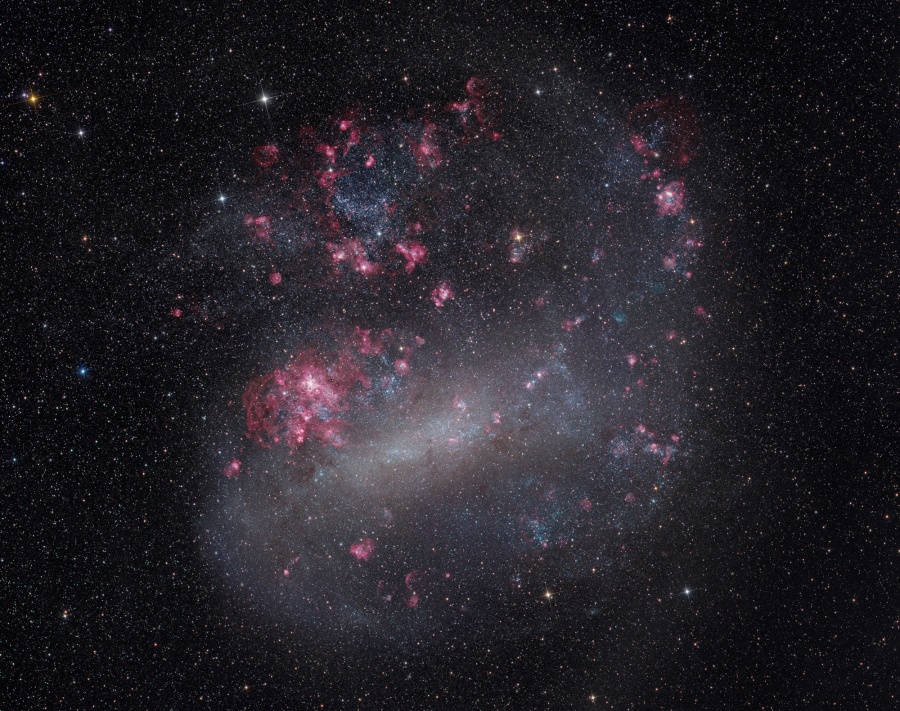
Large Magellanic Cloud
Credit & Copyright: Marco Lorenzi
No matter how you look at it, you don't have to cheat with the Large Magellanic Cloud (Nubecula Major / PGC 17223). This irregular galaxy was noted by al-Sufi (964) and Vespucci (1501) prior to Magalhães but I suppose "Large al-Sufi Cloud" or "Large Aboriginal Cloud" doesn't rhyme quite as well as “Large Magellanic Cloud”. Anyway, LMC harbors the brightest object in another galaxy (the brightest extragalactic object is of course LMC itself). It contains the gigantic (over 25 times larger than the Orion Nebula!) H II region 30 Doradus (Tarantula nebula / NGC 2070) which shines at an impressive magnitude of 4.0[1]. Considering it is an easy naked eye object, the typical apparent magnitude of 8.0 (v) can be considered far too faint. The brightest star in LMC and also the brightest extragalactic star in the sky is S Doradus at 9.5 (v) magnitude (8.6 to 11.5 var). SMC (Nubecula Minor / NGC 292) comes far behind but it contains the conspicious H II region NGC 346 with a magnitude of
6.0-6.5 (v)[2]. The brightest single star in SMC is HD 5980 at 11.3 (v) magnitude which is located inside NGC 346.

After these two (or four, you little cheater...) it becomes a bit trickier. In the Andromeda-piece the extragalactic globular clusters in Fornax Dwarf (Spheroidal) where mentioned. Of the bunch the brightest one is  NGC 1049 @ 12.6 (v) magnitude so it can be spotted even with small apertures. Despite the bright globular clusters, the brightest single stars in Fornax Dwarf are only around 19th magnitude! The hunt for individual stars becomes easier with NGC 6822 (Barnard's galaxy). The brightest stars shine around 15th magnitude so resolving the galaxy should be fairly easy but identifying a star that actually is part of NGC 6822 and seeing it (not just a bunch of resolved stars) is going to be annoying. Oh, and don't forget to bag the brightest H II region in NGC 6822: IC 1308 which shines at around 14th magnitude. Don't get freaked out by the larger aperture sightings of it by Jakiel, Gottlieb, Polakis[3]. IC 1308 is quite visible even with medium apertures.

For globular cluster hunters, here's a list of brightest extragalactic globular clusters.
Host galaxy
Name
Mag (v)


Fornax Dwarf
NGC 1049
12.6
Andromeda galaxy
G1
13.7
NGC 205 (M 110)
G73
14.9
WLM
WLM 1
15.7
Triangulum galaxy
C39
15.9
NGC 147
Hodge 3
16.5
NGC 185
Hodge 5
16.6
NGC 2403
F46
17.5
Messier 81
[PR95] 50225
18.4


References
[1] Stephen O'Meara. Deep-Sky Companions: The Caldwell Objects: page 406.
[2] Visual magnitude estimate by Timo Karhula.
[3] http://www.astronomy-mall.com/Adventures.In.Deep.Space/barnard.htm


Saturday, 3 August 2013

Extragalactic objects in Andromeda galaxy (M31)

The Andromeda galaxy / Messier 31

Even though the H II regions in the Andromeda galaxy are not as prominent as the ones in the Triangulum galaxy, this bad boy beats M33 in globulars that's for sure. When compared to the Triangulum galaxy, ten of the brightest globular clusters are between 13.7 and 14.9 magnitude (15.9 - 17.6 in M33). In total over 300 globular clusters have been identified from the galaxy. That's not all: there's a whooping 60 brighter clusters than 16th magnitude. Should you choose to pursue some of these objects, a good photograph is required. The image to the left shows only a handful of globular clusters, is very simplified and presents just a small part of the entire Andromeda Galaxy. A good place to start is the 1981 Atlas of the Andromeda Galaxy by Paul W. Hodge. Observing Handbook and Catalogue of Deep-Sky Objects by Skiff and Luginbuhl has a basic map on page 17. Night Sky Observer's Guide Volume 1 has a fairly good photography map of M31 on page 16. There is an obvious error though: G78 is marked at the wrong position. If you're looking for a very complete list of objects in M31, the best one is Star Clusters by Hynes & Archinal containing literally hundreds of objects.

Even though only the brightest globular cluster is introduced, I encourage everyone to try to observe as many of them as possible. Several of the extragalactic globulars can be seen even with small apertures between 4 to 6 inches. So far I've been able to detect 7 of the brightest globular clusters using my 4.7" Sky-Watcher under typical truly dark skies of Finland. If you live south enough be sure to log NGC 1049 (Hodge 3) located in the Fornax dwarf galaxy. This globular cluster beats Andromeda's G1 in brightness (by over a magnitude) as do the three other globulars in the same galaxy.


OB association NGC 206

RA: 00 40 31 Dec: +40 44 16
NGC 206 is the most prominent object in the entire Andromeda Galaxy. What I can remember about this star cloud is that it should be "kidney-shaped" and it slightly is. Still, have we really gone so low that we're spotting kidneys at the eyepiece these days? Apparently so! In any case, NGC 206 is so bright and obvious under good conditions that I wouldn't be surprised if someone came forth and claimed it to be visible with a pair of binoculars. It is just so conspicuous and cuddly even using a simple 3 inch telescope. With little research it seems like the brightest star in the NGC 206 association and in the entire Andromeda galaxy is #12 by a paper by Odewahn (1987) at magnitude 16.0 (v). The star is marked in the image on the left.


OB association A 54


RA: 00 44 33 Dec: +41 52 30
This association is nearly as large as NGC 206 but a lot fainter. Generally listed as a magnitude 16 object it still is visible with medium apertures such as 8 to 10 inches of aperture. It appears as a NE-SW elongated, slightly mottled patch of light in the near the NE tip of the galaxy. It is even mentioned in the 1998 (2. edition) Observing Handbook and Catalogue of Deep-Sky Objects as being visible in a 10" telescope.


H II region C 410


RA: 00 44 25.1 Dec: +41 20 42
C 410 is the brightest H II region (+ and open cluster) in the Andromeda galaxy according to the book Atlas of Messier Objects. The object is located between the globular clusters G272 and G280. Not much else can be said about it as I have not seen this object myself.


Globular cluster G1 / Mayall II / NGC-224-G1 / SKHB 1


RA: 00 32 46 Dec: +39 34 40
As even the image above shows this is a big boy - especially when you keep in mind the distance of at least 2.5 million light years. As an example the remote globular cluster NGC 2419 is roughly 300 000 light years away. It is still uncertain if this object is actually a dwarf galaxy or simply a giant globular cluster. Compared to the biggest globular cluster in our Milky Way, Omega Centauri, G1 is twice as massive.[1]

G 1 forms a tight triangle with a pair of nearly 15th magnitude stars. With small apertures and small magnification this group forms a single, stellar point of light. Many observers say that in order to claim G1 as seen, one should resolve it from the two nearby stars. This can be done with small apertures such as 4 to 6 inches but requires high magnification and so good seeing as well. However, claiming G1 as seen does not require you to separate these two faint stars from the cluster. The non-stellar appearance is quite easily achieved even under suburban skies using 6 to 8 inches of aperture.

Finding G1 might require a bit of patience if you're unfamiliar with the field or star hopping in general (for some reason). Tom Trusock wrote in his 2006 Small Wonders column that: "While it's not a toughie to see - if you have sufficient aperture - it can be a real pistol to find."[2] I assume this means that G1 difficult to find but it makes me wonder why. Maybe it is aperture related? To me the globular is basically just two star hops away. I will not go into specifics but I will explain you which one I use and the one I think is the easiest. First locate the 5th magnitude star 32 Andromedae which should be visible at least with your finder. From this star simply move to the north-west until you locate the 7th magnitude star HD 2993. This star has two fainter stars to the south the last one in line is 9th magnitude PPM 65429. From here, move less than 15' to the west and here is G 1. The key is just to get the finder and/or stars orientated the right way. Once you get it, rest is easy.


Star AF Andromedae

RA: 00 43 33.1 Dec: 41 12 10

The hypergiant AF And is one of the most luminous stars known with an absolute magnitude of -10.6 (our Sun is +4.5). This irregularly variable LBV is generally fainter than 17th magnitude but has had two brief eruptions in 1970-1974 and 1987-1992 when it was somewhere in the 16th magnitude. When measured between September 1992 and January 1993 (by Szeifert, T. et al.) it showed some variability from 16.91 to 17.14 magnitude.[3]


Star AE Andromedae


RA: 00 43 02.5  Dec: +41 49 12
This too is a bit on the heavy side although not as massive as AF And. With an absolute magnitude of -9.4 it still ranks high (top 20) in the most luminous list. As with AF Andromeda, this is a LBV star which has irregular eruptions. The last eruption was back in 1928 when the star flared up (and was also discovered for the first time) to an impressive object brighter than 15th magnitude. Between September 1992 and January 1993 CCD photometry was taken from the the star and it showed only a little variability: 17.56 - 17.59.[3]


Star A1 Andromedae

RA: 00 44 50.57 Dec: +41 30 38

This star is located in a H II region A41. Out of the three most well known LBV stars in Andromeda galaxy, A1 And is the brightest. Once again photometry obtained between September 1992 and January 1993 showed this giant star at 16.18 - 16.59 magnitude.[3]


References:

Atlas of Messier Objects. Ronald Stoyan et al. 2008.
[1] MAYALL II = G1 IN M31: GIANT GLOBULAR CLUSTER OR CORE OF A DWARF
ELLIPTICAL GALAXY? G. Meylan et al. 2001. http://arxiv.org/abs/astro-ph/0105013
[2] Tom Trusock. Small Wonders: Deep Andromeda Satellite Galaxies, Star Clouds and Globular Clusters of M31
[3] HST and groundbased observations of the `Hubble-Sandage' variables in M 31 and M 33. Szeifert, T. et al.
Images copyrighted by The Digitized Sky Survey.