Saturday, 16 April 2016

Deep Sky column 3/2016: OJ 287 & 3C 273


3/2016 column features BL Lac object OJ 287 and quasar 3C 273.

UGC 6132  (Markarian 421) was also featured in the draft version but was cropped later on due to length issues.


Illustration sketches:
OJ 287 - 8" Orion DSE
3C 273 - 4.5" Orion SkyQuest

Monday, 1 February 2016

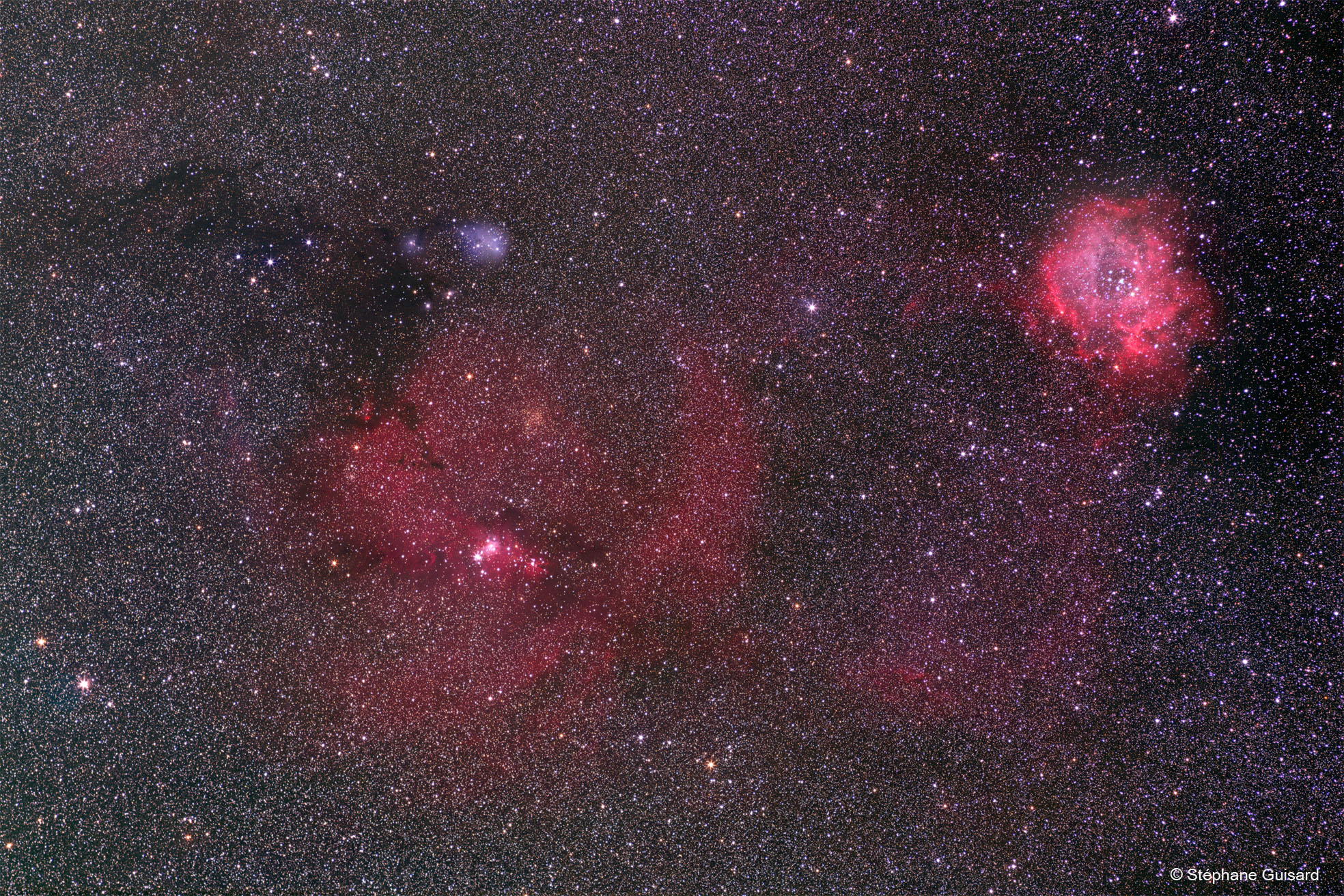
Deep Sky column 1/2016: NGC 2237, NGC 2264, Trumpler 5, IC 447 and Barnard 37


This column has a different look to it. The idea was to select a good (wide field) photograph from an interesting region in the winter sky and simply do an article based on it.

The region selected is the famous "Heart of Monoceros" featuring - most notably - Rosette and Cone nebulae. Other region under consideration was "Heart of Auriga" featuring IC 405, IC 410, IC 417 and NGC 1931 which will probably be done next year.

The image in the background is by Stéphane Guisard - http://sguisard.astrosurf.com/Pagim/SGU-Cone-Rosette-STL-200mm-M-cp8.jpg

Sunday, 10 January 2016

Treasure Island: Lynx the Bobcat


Alessi 2
Size: 30'
Type: IV 3 m
Notes: Br * 8.8

Sunday, 4 October 2015

Deep Sky column 7/2015: NGC 7789 & NGC 7243


The original column featured NGC 7789, NGC 7243 and NGC 752 but it was cropped early on.

NGC 7789 is one of the finest open clusters in the northern hemisphere. It was discovered by Caroline Herschel on 30th of October 1789 using a modest 10 centimeter f/6.4 Newton. It features roughly 600 stars within 20' of which the brightest is 10th magnitude. Visually the object is less than 10' in size.

Loosely translated my friend Iiro described the object as "a labyrinth of dark pathways and starless regions".

NGC 7243 is an old favorite of mine. Several shapes can be discerned from the object most common one being a bird flying directly to the viewer. Brightest star in the cluster is 8.5 magnitude. Size of the object is 17' with a total number of stars visible with an 8 inch Orion DSE: ~150. Illustration (from my part) featured a sketch of NGC 7243:
4.5 " Orion SkyQuest @ 101x (30')

Wednesday, 1 July 2015

Deep Sky column 5/2015: Dwarfs and Giants

Summer and non-deep sky oriented column due to midnight sun.

Massive star: LBV candidate Cyg OB2 #12 (HIP 101364). 11.4 magnitude star with ~110 M☉ and bolometric magnitude ~10.9. Dwarfed by R136a1 (~256 solar masses) in NGC 2070 (LMC - Dorado).

A star close to us: Lalande 21185 in Ursa Major. The star is only 8,3 light years away. At magnitude 7.5 is it also a naked eye object under excellent conditions. Absolute magnitude is quite faint: ~10.5.

Tiny star: Barnard's star. Closer to us than Lalande 21185 but a lot smaller: 0.14 M☉and with an absolute magnitude of only 13,2. The star has only 150 times more mass the Jupiter. Moves 10" in the sky per year - that's 90 km/s. Not discovered by E. E. Barnard.

Far far away: 6th magnitude Rho Cassiopeia. Distance estimates vary greatly: between 6000 and 16 000 light years. Commonly referred as the most distant (single) star visible to the naked eye. Radius is at least 400 R☉ then again dwarfed by UY Scuti (~1700 solar radii). Another distant star to the naked eye: V762 Cas, possibly even 15 000 light years away.